In today's digital age, a reliable and efficient network is essential for businesses to thrive. One technology that is gaining significant attention in the broadband industry is XGS PON (10 Gigabit Symmetrical Passive Optical Network). XGS-PON is an ideal symmetric network solution that offers high bandwidth and low cost. It supports symmetrical data rates up to 10Gb/s with integrated QoS. This article will provide an overview of XGS-PON.

What is an XGS-PON?
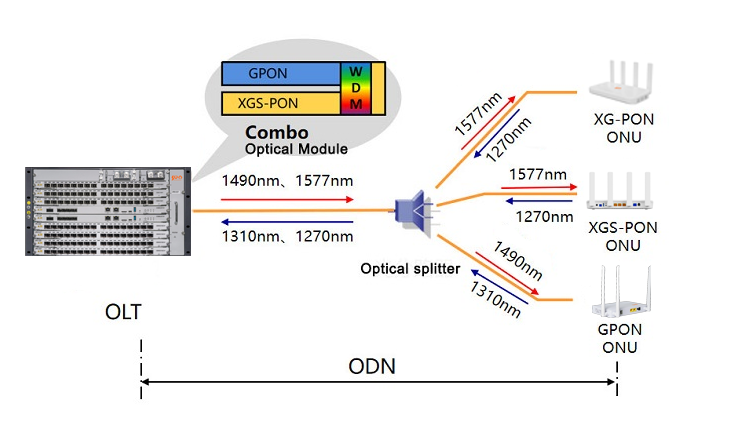
XGS-PON is an updated standard for PON that can support high-speed 10 Gbps symmetrical data transfer and is part of the family of standards known as Gigabit-capable PON, or GPON. GPON stands for Gigabit PON or 1 Gigabit PON. The “X” in XGS represents the number 10, “G” stands for Gigabit, and the letter “S” stands for symmetrical, XGS-PON = 10 Gigabit Symmetrical PON. In addition, XGS-PON uses a point-to-multipoint (P2MP) architecture, where a single OLT can connect to multiple ONUs using a single optical fiber. This is acquired by using optical splitters, which divide the optical signal from the OLT into multiple branches, each serving a separate ONU. In addition, XGS-PON uses wavelength division multiplexing (WDM) to transmit downstream and upstream traffic on different wavelengths over the same optical fiber.
What are the Components of XGS-PON?
1) XGS-PON SFP+ Transceiver
XGS-PON SFP+ transceiver is a hot-pluggable optical transceiver module designed for a 10Gigabit capable passive optical network (XGS-PON) system. It integrates bidirectional data transmission over one single-mode optical fiber (SMF). In addition, it provides a symmetric 9.95 Gbps upstream and 9.95G/2.488Gbps downstream data rate, reaching a link up to 20km via an SC/UPC connector.
2) XGS-PON OLT
For all PON standards, including XGS-PON, lies the OLT(Optical Line Terminal) located in the local office of service providers. The XGS-PON OLT efficiently disseminates identical data to all ONTs(Optical Network Terminals) within the network, thanks to the passive downstream optical splitters in operation.
3) XGS-PON ONT/ONU
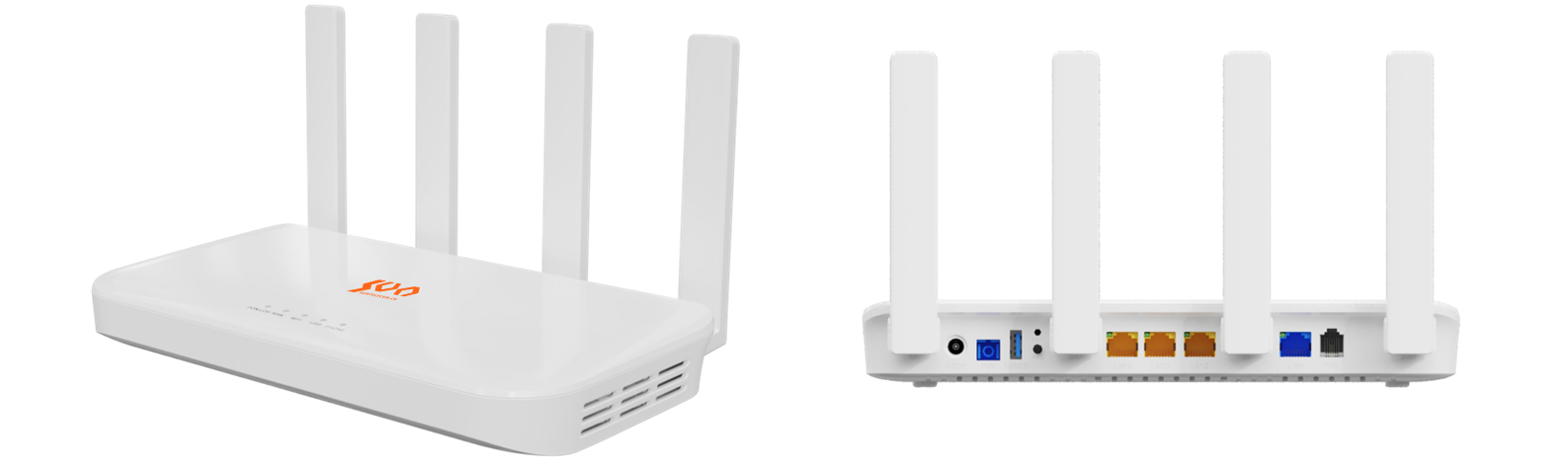
Using single or cascaded optical splitters, the OLT's downstream wavelength can be split to provide service to as many as 128 end devices (ONTs), also known as ONUs (Optical Network Units ), according to IEEE terminology. Recent innovations in packaging, optics, and chip design have significantly reduced the cost of 10G ONTs, bringing them closer to the levels of 1G ONTs/ONUs. As XGS-PON deployment gains momentum, economies of scale will further enhance efficiency. Newer generation XGS-PON ONTs offer increased flexibility, enabling common hardware elements for FTTH, business, and 5G applications.
What are the Benefits of Using XGS-PON?
1.High Bandwidth: With a data rate capacity of up to 10 Gbps, XGS-PON enables service providers to meet the demands of bandwidth-intensive applications, delivering high-speed Internet access to end-users and accommodating evolving connectivity needs.
2.Easy Scalability: XGS-PON provides corresponding optical modules for ODN networks with multi-level link budgets and splitting ratios, making network upgrades more flexible.
3.Enhanced Network Efficiency: XGS-PON provides higher data rates over greater distances than traditional GPON.It allows service providers to deliver Gigabit-rate services across existing fiber infrastructure.
4.Improved Reliability: XGS-PON improved network robustness and resilience via a 2-fiber P2MP architecture that allows for greater redundancy and fewer single points of failure.
5.Low Latency: XGSPON improved network performance with lower latency compared to traditional GPON services. This can be especially beneficial for applications that require low latency, such as streaming media or cloud computing applications.
6.Increased Security: XGS-PON supports advanced encryption technology, providing robust security for customer data and safeguarding service providers' networks against malicious attacks or unauthorized access.
Applications
XGS-PON is used in residence/business, high-definition video streaming, online gaming, video conferencing, virtual reality (VR), augmented reality (AR), cloud computing, FTTx, data centers, etc.

Conclusion
XGS-PON is the next generation of PON technology. It provides high speed, reliability, security, and low latency. It plays a crucial role in shaping the future of digital connectivity across diverse industries.
Sun Telecom specializes in providing one-stop total fiber optic solutions for all fiber optic application industries worldwide. Contact us if you have any needs.





 Position :
Home>
News & Tutorial
>Products
Position :
Home>
News & Tutorial
>Products













 ics@suntelecom.cn
  +86 18964888554
 Building No.145, Lane 666 Xianing Road, Jinshan Industrial Zone, Shanghai 201506, China




 +86 21 60138638


