As data rates increase in the data center, OM5 fiber optic cable, also known as wideband multi-mode fiber (WBMMF), allows the use of Short Wavelength Division Multiplexing (SWDM) technology to transmit multiple signals on one fiber, increasing the bandwidth of a single fiber by at least four. OM5 cable is suitable for high-speed data centers and next-generation wideband network applications. This article will introduce OM5 fiber optic cable in detail.
What is OM5 Cable?
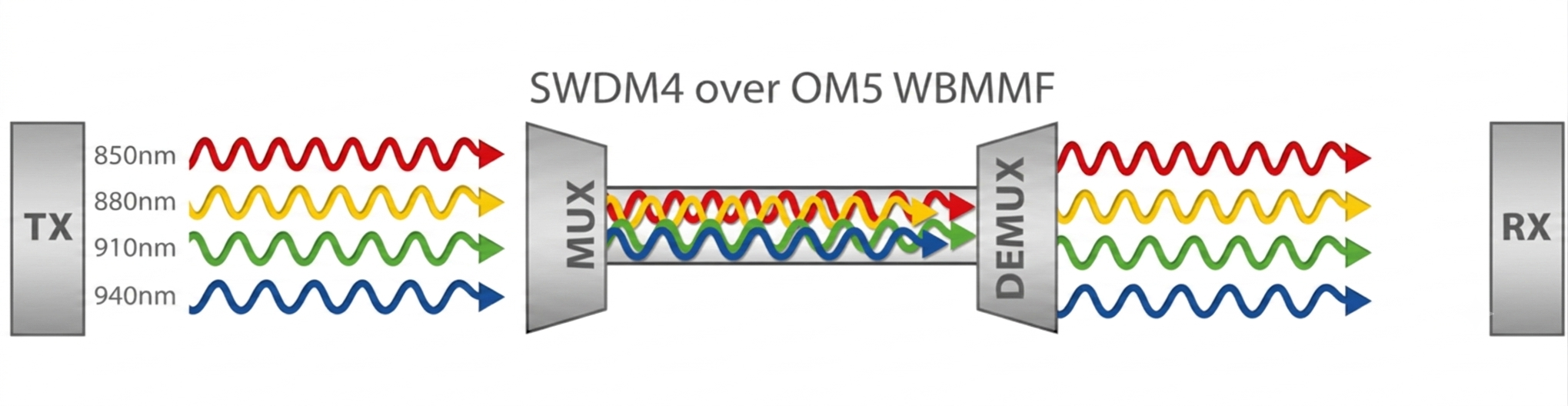
OM5 cable is a multi-mode fiber optic cable used in high-speed data centers and other high-performance computing environments. It supports at least four low-cost wavelengths in the 850-950 nm range, enabling optimal support of emerging SWDM applications that reduce parallel fiber count by at least a factor of four to allow continued use of two just fibers (rather than eight) for transmitting 40/100G and reduced fiber counts for higher speeds. OM5 cable has a clear EMB (Effective Modal Bandwidth) and low attenuation.
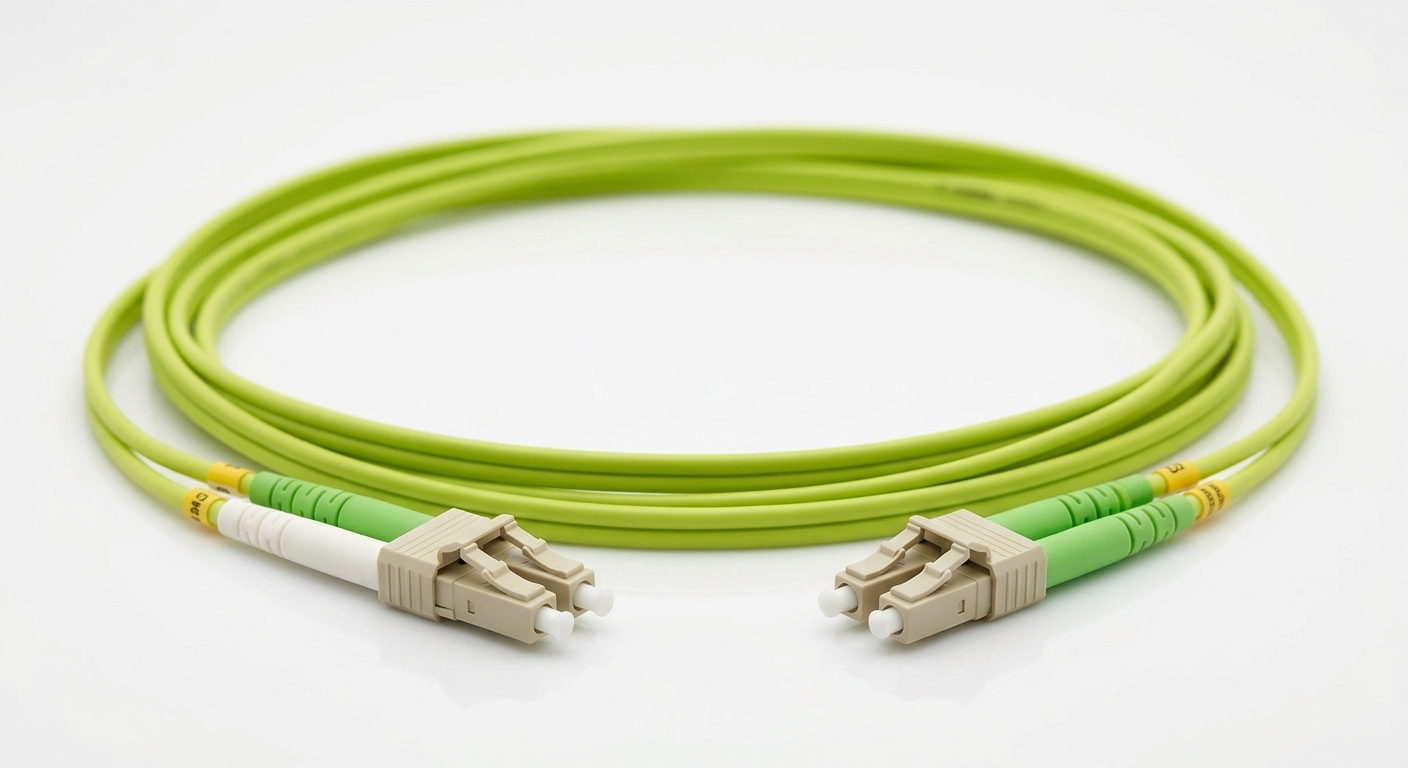
OM5 cable is 100% standards compliant with OM3 and OM4 cables, with an additional requirement for DMD (Differential Mode Delay) that compensates for modal and chromatic dispersion. It includes extra bandwidth characterization at 953 nm to support extended distances when using SWDM. OM5 cable applies to data centers that require quick infrastructure deployment with extended reach and want to maintain bandwidth throughout the infrastructure.
What is SWDM?
SWDM is a technique that uses four wavelengths across the 850 to 950 nm range. SWDM transceivers are designed to use 2-fiber connectivity into the transceiver with OM3/OM4/OM5. Shortwave data center connections are typically powered by VCSELs (Vertical Cavity Surface-Emitting Laser) operating near a wavelength of 850 nm.
According to SWDM4 MSA technical specifications, the 40/100GbE expected maximum operational distances are given in the table below.
| Standard |
OM3 |
OM4 |
OM5 |
| 40G SWDM |
240 m |
350 m |
440 m |
| 100G SWDM |
75 m |
100 m |
150 m |
Key Features
OM5 cable provides the following key features:
1. High reliability, and flexibility
2. High bandwidth and speed
3. Backward compatible with OM3 and OM4
4. Long transmission distance and less use of fibers
5. Easy management and installation
OM3 vs. OM4 vs. OM5 Cables: What's the Difference?
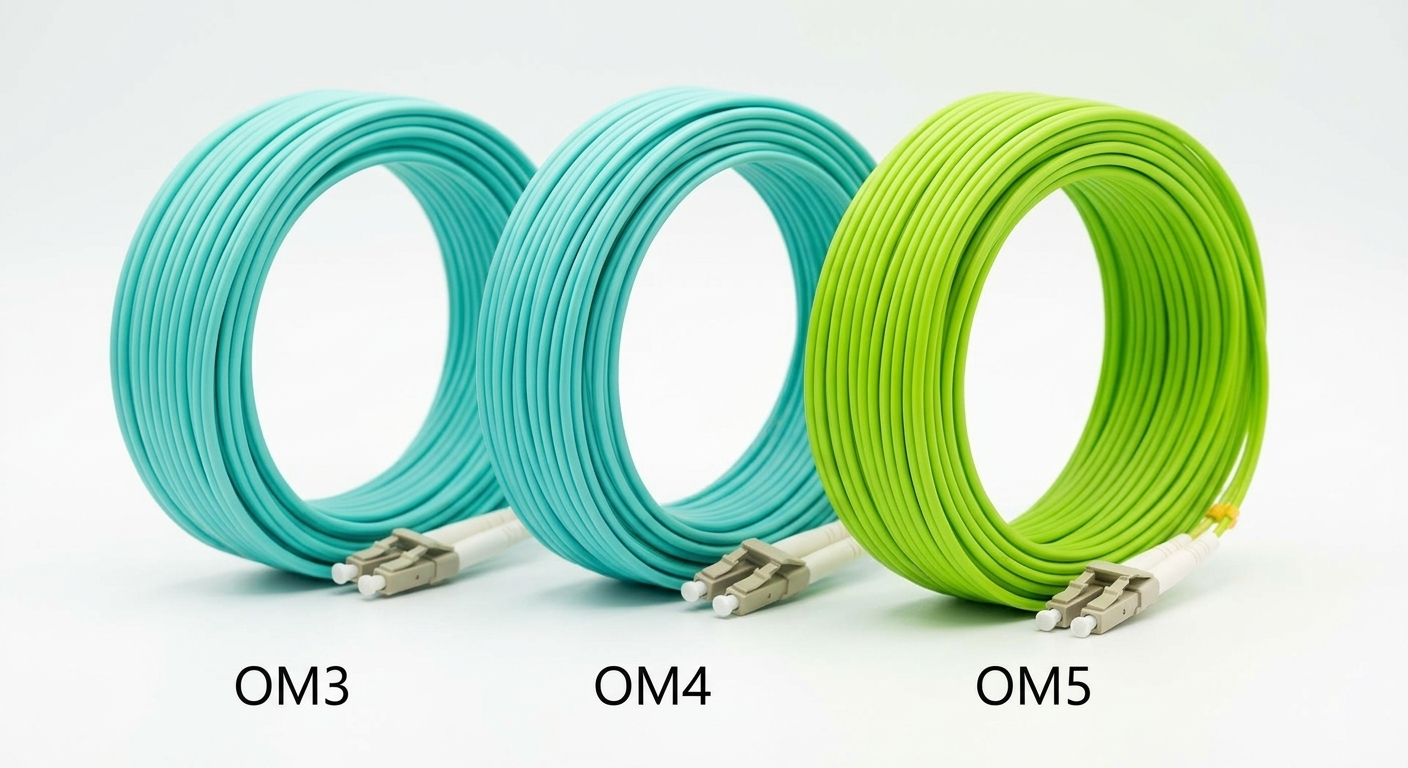
OM3 cable is a multi-mode fiber with a 50 µm core optimized by an 850nm VSCEL laser light source and can achieve a transmission distance of 300m.OM4 cable is an upgraded version of OM3 and uses VSCEL laser transmission and allows 10G distances of up to 550m.OM5 cable a is the newest type of multi-mode fiber defined by TIA (Telecommunications Industry Association) and IEC (International Electrotechnical Commission), with a fiber diameter of 50/125 μm. The color jacket of OM5 cable is lime green, while OM3 and OM4 are aqua color. Compared with OM3 and OM4 fiber patch cables, OM5 has high scalability and flexibility and can support higher bandwidth and speed data transmission over long transmission distances. EMB is specified only at 850 nm for OM3 fiber ≥1770 MHz・km and OM4 fiber ≥4160 MHz・km. OM5 EMB values are specified at both 850 and 953 nm.
Applications
OM5 cable is used in data centers, storage area networks, communications rooms, telecom networks, backbone networks, campus networks, CATV, LAN, etc.
Conclusion
OM5 cable can support SWDM applications within the wavelength range of 850-953 nm. Thus, OM5 cables provide high bandwidth and speed and are suitable for network environments that require high-speed data transmission, especially in data centers and other high-performance computing environments.
Sun Telecom provides total and customized solutions of fiber optic products to the global market. Contact us if you have any needs.





 Position :
Home>
News & Tutorial
>Products
Position :
Home>
News & Tutorial
>Products











 ics@suntelecom.cn
  +86 18964888554
 Building No.145, Lane 666 Xianing Road, Jinshan Industrial Zone, Shanghai 201506, China




 +86 21 60138638


