GPON (Gigabit Passive Optical Network) is a point-to-multipoint (P2MP) access network technology that delivers broadband access to the end user via fiber optic cable. It provides high bandwidth, security, scalability, and low cost. As user demand for high bandwidth continues to grow, GPON is gradually evolving towards 10G GPON, which includes XG-PON and XGS-PON. This article highlights what are the differences between XG-PON and XGS-PON.
XG-PON vs. XGS-PON: What's the Difference?
XG-PON(10G-PON), standardized by ITU-T G.987.1, represents an upgrade to GPON. It supports downstream speeds of up to 10 Gbps and upstream speeds of up to 2.5 Gbps, offering users high bandwidth support. XG-PON is an asymmetric 10G GPON, providing asymmetric transmission rates. It is suitable for bandwidth-intensive applications such as high-definition video streaming, online gaming, cloud computing, enterprise, and data centers.
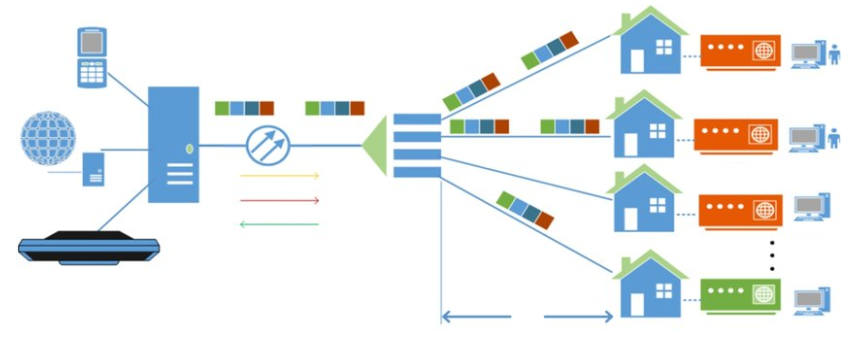
XGS-PON, standardized by ITU-T G.9807.1, is an updated standard for PON that can support high-speed 10 Gbps symmetrical data transfer. It supports downstream speeds of up to 10 Gbps and upstream speeds of up to 10 Gbps. It is suitable for applications that require high upstream bandwidth, such as video conferencing, real-time collaboration, cloud-based file sharing, enterprise, data center, 5G back-haul/front-haul, smart city, and IoT.
XG-PON and XGS-PON belong to the GPON series. From the technical roadmap, XGS-PON is the technological evolution of XG-PON. In addition, XG-PON and XGS-PON are 10G PONs. The main difference is that XG-PON is an asymmetric PON, and the uplink/downlink rate of the PON port is 2.5G/10G; XGS-PON is a symmetrical PON, and the uplink/downlink rate of the PON port is 10G/10G. The following table summary the differences between the two standards:
|
Specification
|
XG-PON
|
XGS-PON
|
|
Downstream Speed
|
10 Gbps
|
10 Gbps
|
|
Upstream Speed
|
2.5 Gbps
|
10 Gbps
|
|
Symmetry
|
Asymmetric
|
Symmetric
|
|
Center Wavelength
|
Downstream: 1577 nm
|
Downstream: 1577 nm
|
|
Upstream: 1270nm
|
Upstream:1270nm
|
|
Maximum Physical Transmission Distance
|
100km
|
100km
|
|
Maximum Split Ratio
|
1:256
|
1:256
|
Coexistence of XGS-PON and XG-PON
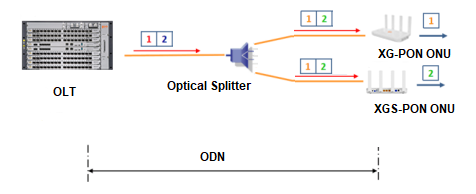
Like XG-PON, the downlink of XGS-PON adopts broadcast mode, and the uplink adopts TDMA mode. Since the downlink wavelength and downlink rate of XGS-PON and XG-PON are the same, the downlink of XGS-PON does not differentiate between XGS-PON ONU (Optical Network Unit) and XG-PON ONU, and the optical splitter enables the downlink optical signal to the same ODN (Optical Distribution Network) link for each XG(S)-PON (XG-PON and XGS-PON) ONU, each ONU chooses to receive its signal and discard other signals.
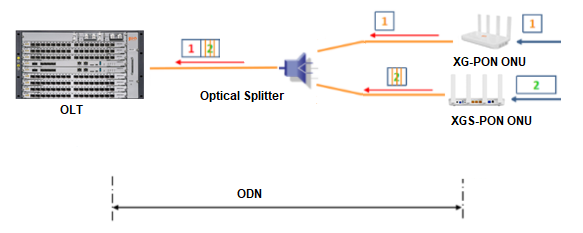
The upstream of the XGS-PON transmits data according to the time slot, and the ONU sends the data in the time slot permitted by the OLT. The OLT dynamically allocates time slots according to the traffic requirements of different ONUs and the types of ONUs (XG-PON or XGS-PON). In the time slot allocated to the XG-PON ONU, the data transmission rate is 2.5Gbps; in the time slot allocated to the XGS-PON ONU, the data transmission rate is 10Gbps. XGS-PON naturally supports hybrid access with two ONUs, XG-PON and XGS-PON.
Conclusion
In conclusion, XG-PON and XGS-PON provide significantly higher speeds of up to 10 Gbps downstream and 2.5 Gbps in the latter. In addition, XGS-PON may be the best choice to meet the present and future needs, such as safety, speed, and bandwidth capacity.
Sun Telecom specializes in providing one-stop total fiber optic solutions for all fiber optic application industries worldwide. Contact us if you have any needs.





 Position :
Home>
News & Tutorial
>Products
Position :
Home>
News & Tutorial
>Products











 ics@suntelecom.cn
  +86 18964888554
 Building No.145, Lane 666 Xianing Road, Jinshan Industrial Zone, Shanghai 201506, China




 +86 21 60138638


