

News & Tutorial

To Provide You With The Latest Product Information And Company News

Do you know your Internet Explorer is out of date?

To get the best experience for our site, we recommend you upgrade to the latest version of Internet Explorer, or select another web browser, a list of the most popular web browsers can be found below

You can download the main browser here:

Position : Home> News & Tutorial >Products

Dispersion Compensation Module (DCM): The Cost-Effective Solution for Long-Haul DWDM Network

Date: 2025-09-30 16:23:34

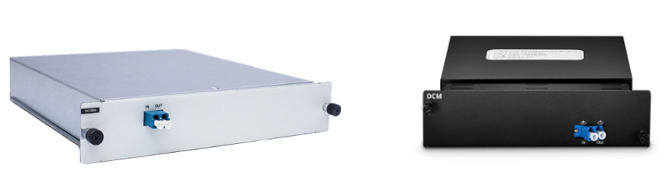
dispersion compensation module (DCM) is a cost-effective solution for long-haul DWDM (Dense Wavelength Division Multiplexing) networks. It is used to compensate for the chromatic dispersion of long-span transmission fibers. DCM provides a high-speed network and a high degree of freedom connection budget. Follow this article to learn more about DCM.
 
\

What is DCM?
DCM, also called DCU (Dispersion Compensation Unit), is a device designed to fix the form of optical signals that are deformed by chromatic dispersion. The main constituent of DCM is DCF (Dispersion Compensation Fiber) with a negative chromatic dispersion value within the wavelength range between 1525nm and 1565nm. It provides a high level of compensation while maintaining a low flat insertion loss. When combined with EDFA (Erbium-Doped Fiber amplifier ) and OEO(Optical-Electrical-Optical), signals go further without regeneration. DCM can be deployed in various places in the network, which can provide pre-, post-, and symmetrical compensation in DWDM networks.
 
\

What is the Purpose of the DCM?
Dispersion occurs when an optical signal travels long distances in an optical fiber, resulting in signal distortion.The DCM compensates for the cumulative dispersion in a single-mode fiber (SMF), and a dispersion coefficient is used to characterize the dispersion value. The value for regular SMF is around +16~17 ps/(nm*km) at 1550 nm. DCM is built by using a special type of dispersion compensating fiber inside the module that has a negative value of dispersion coefficient, ranging from -30 to -300 ps/(nm*km). DCM can achieve -10 to -2100 ps/nm of dispersion values at 1550 nm wavelength and offer a high-level compensation for standard SMF (SMF28 – G.652 fiber) across the entire C-Band while maintaining a low flat insertion loss and latency. When combined with EDFA and OEO, DCM provides a simple, reliable, and cost-effective long-haul transport solution, making signals go further without regeneration. DCM provides a fixed amount of dispersion (normal dispersion in the 1.6-μm spectral region), although tunable dispersion modules are also available. It can easily be inserted into a fiber-optic link because it has fiber connectors for the input and output. The insertion losses may be compensated with a fiber amplifier (EDFA in a 1.5-μm telecom system). A DCM is often placed between two fiber amplifiers in a long-haul DWDM system.

What are the Features and Benefits of DCM?
DCM provides the following features and benefits:
1. 100% slope compensation and wideband dispersion compensation
2. Low insertion loss and polarization mode dispersion
3. Low-cost and long-distance DWDM optimization
4. Individual compensation levels and protocols transparent
5. Flexible and compact design
6. Passive device and easy to install

Application 
DCM is used in long-haul DWDM networks, EDFA, telecommunication networks, CATV networks, SDH/SONET, etc.

Conclusion
DCM compensates for the dispersion effects by introducing the opposite dispersion of optical signals in the fiber, thereby maintaining the integrity and signal quality. It uses fiber Bragg gratings or fiber delay lines technologies to achieve dispersion compensation. In addition, DCM provides the perfect opportunity to build SDH/SONET, CATV, and DWDM network systems.
Sun Telecom specializes in providing one-stop total fiber optic solutions for all fiber optic application industries worldwide. Contact us if you have any needs.

Position : Home >Products

Related News

How to Choose the Right OADM for Your WDM Mux/Demux Application?

In the WDM Mux/Demux system, OADM (Optical Add-Drop Multiplexe...

Learn More
ROADM: Best Choice for 400G WDM Transmission

To solve some of the 400G WDM transmission problems, such as...

Learn More

Unlocking Success with OADM: A Comprehensive Guide to DWDM Network

OADM (Optical Add-Drop Multiplexer) plays a vital role in DWDM networks.

Learn More
Optical Performance Monitoring (OPM) for High Speed DWDM Networks

Optical performance monitoring (OPM) provides cost-effective and...

Learn More
MTP/MPO Cassette: The Ultimate Solution for High-Density Data Center Application

MTP/MPO cassette helps to improve network operation efficiency and cabling system scalability.

Learn More