FTTX plays a crucial role in providing high-speed broadband internet access for a global network. The growth of fiber optic networks has allowed telecom operators to optimize FTTX with the most effective, cost-efficient connectivity and bandwidth capabilities.
What is FTTX?
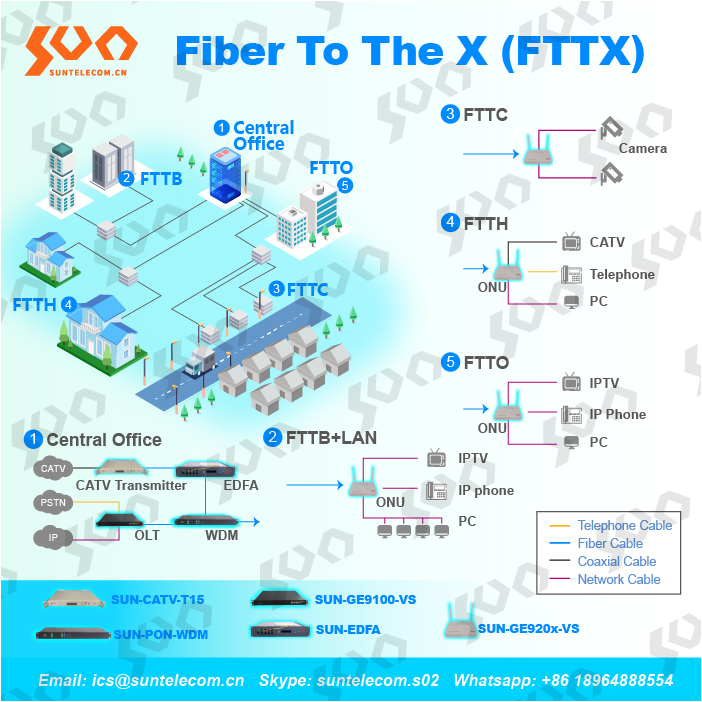
FTTX ( fiber to the X) is the collective term used to describe a wide range of fiber optic access infrastructure. The ’X’ represents the fiber termination point. FTTX has many benefits like high reliability, high speed, high bandwidth, higher transmission rates, high quality of service (QoS), flexible deployment options, lower energy consumption, and reduced costs of service delivery and maintenance.
Types of FTTx
FTTX types include fiber to the home (FTTH), fiber to the building (FTTB), fiber to the curb or cabinet (FTTC), fiber to the office (FTTO), fiber to the node (FTTN), fiber-to-the-antenna (FTTA), etc. Listed below are the most common ones.
FTTH
FTTH (also referred to as a subset of fiber to the premises, FTTP) is the installation and use of optical fiber and passive optical network technology (such as GPON or GEPON) from a central point directly to individual buildings such as homes, apartment buildings, businesses, and schools, providing high-speed internet access.
FTTB
Unlike FTTH where fiber enters each individual living unit, in FTTB the fiber terminates at a common point within a multi-dwelling unit (MDU), such as a basement or designated electrical room. The 'B' stands for building. From this termination point, copper cables (e.g., xDSL) or Ethernet cables distribute the signal to individual units.
FTTC
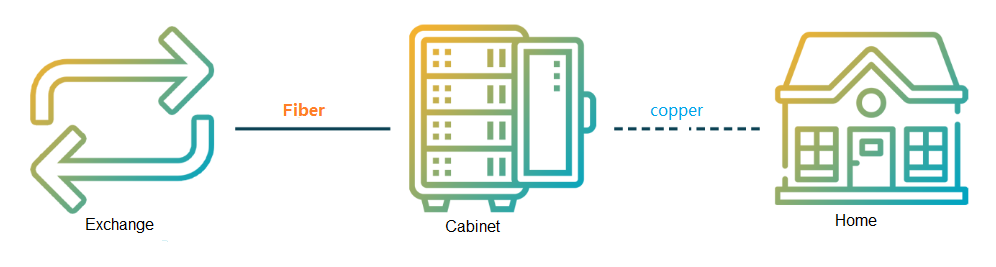
FTTC is a broadband technology that uses fiber optic and copper cables to connect homes and businesses to broadband internet. The fiber runs from the telephone exchange (or distribution point) to a street cabinet, and from the street cabinet to the home/business premises via existing copper lines (such as twisted-pair telephone lines or coaxial cables)
FTTN
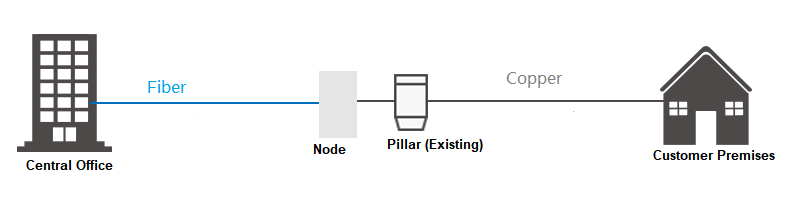
FTTN uses fiber optic cable that runs from a central office (CO) and terminates at a distribution node (typically located 300 meters to several kilometers from the customer premises) , with the final connections being copper or coaxial cables. Unlike FTTC where the cabinet is located much closer (typically within 300 meters), FTTN nodes are positioned farther away and serve larger customer areas.
FTTA
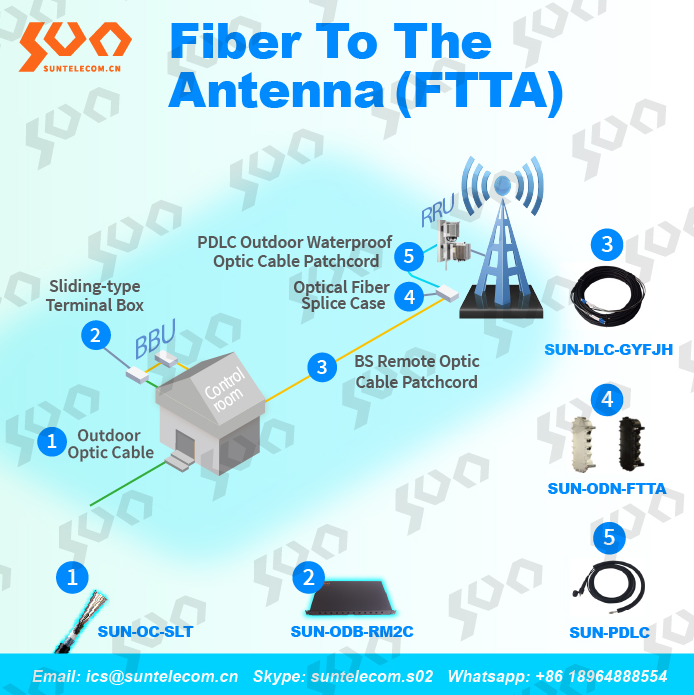
FTTA is a broadband network architecture that uses fiber optics to connect the baseband unit (BBU) to the remote radio unit (RRU) at the top of a tower, replacing all or part of the traditional coaxial feeder network. FTTA technology can greatly reduce signal power loss and is commonly used in conjunction with CPRI (Common Public Radio Interface) or eCPRI protocols. Up to 20km maximum transmission distance helps realize centralized placement of base stations in lower-cost telecommunication rooms as well as more flexible and modularized network planning. (Note: In practice, CPRI/eCPRI latency requirements often limit the feasible transmission distance.) FTTA is an innovative, flexible, and future-oriented way to install mobile fronthaul networks.
Applications of FTTX
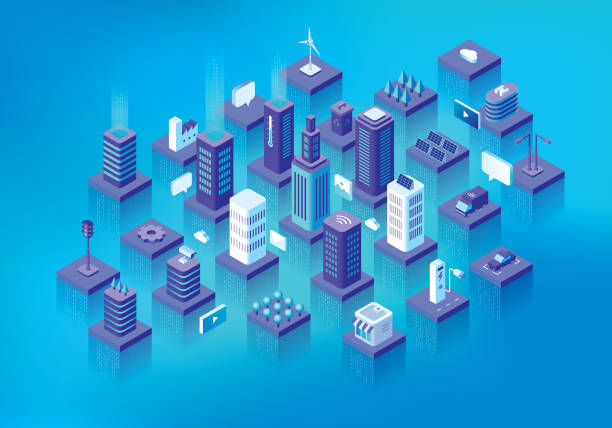
The applications of FTTX include residential and business broadband access, IPTV, HDTV, CATV, IP phone, voice and data, online gaming, e-learning, e-Health, smart home, smart city, internet of things (IoT), virtual reality (VR), and industrial sectors such as automation, transportation, energy and utilities, oil and gas, military, etc.
Conclusion
The advent of FTTX is of great significance for people around the world. FTTX provides high speed, high bandwidth, high reliability, and low latency than copper and other technologies. Sun Telecom offers a range of FTTX solutions and products to the global market.





 Position :
Home>
News & Tutorial
>Products
Position :
Home>
News & Tutorial
>Products











 ics@suntelecom.cn
  +86 18964888554
 Building No.145, Lane 666 Xianing Road, Jinshan Industrial Zone, Shanghai 201506, China




 +86 21 60138638


